Contemporary Assemblage Artist · Philippines
Glenn Martinez
Storied Artifacts from Memory, Heritage, and Belief
Scroll
Contemporary Assemblage Artist · Philippines
Storied Artifacts from Memory, Heritage, and Belief
Curatorial Introduction
"Fused with disparate materials, Martinez's works point out that human experience and human imagination are results of acts of assemblage." — Prof. Jose Santos P. Ardivilla, University of the Philippines
Glenn Martinez gathers the world in order to rebuild it. From marketplaces, antique stores, coastal towns, and the domestic shelves of memory, he collects objects that already carry lives before they arrive in his studio. His practice is part archaeology, part storytelling — the art of arranging unrelated things until they agree to form a new narrative together.
His assemblages function as shrines, museum boxes, reliquaries, curiosity cabinets, and elaborated fictions. Each work suspends time: a carved wooden figure beside a brass instrument, a glass dome over a birdlike form, a painted retablo holding forgotten Catholic iconography and traveler's tokens. The pieces speak across centuries and cultures, borrowing from Filipino baroque devotion, pre-colonial mythology, and the quiet surrealism of the everyday.
Rooted in the Philippine tradition of sacred object-keeping and shaped by a decade of cultural travel and photo essay writing, Martinez's practice transformed into full-time assemblage art in 2020. Since then, his works have entered private collections in the Philippines, the United States, Spain, Finland, Thailand, and the United Kingdom — and hold permanent residence at Musee d'Arsie in Metro Iloilo Modern Arts Park.
I
On found energy, invention, and the moment before everything begins
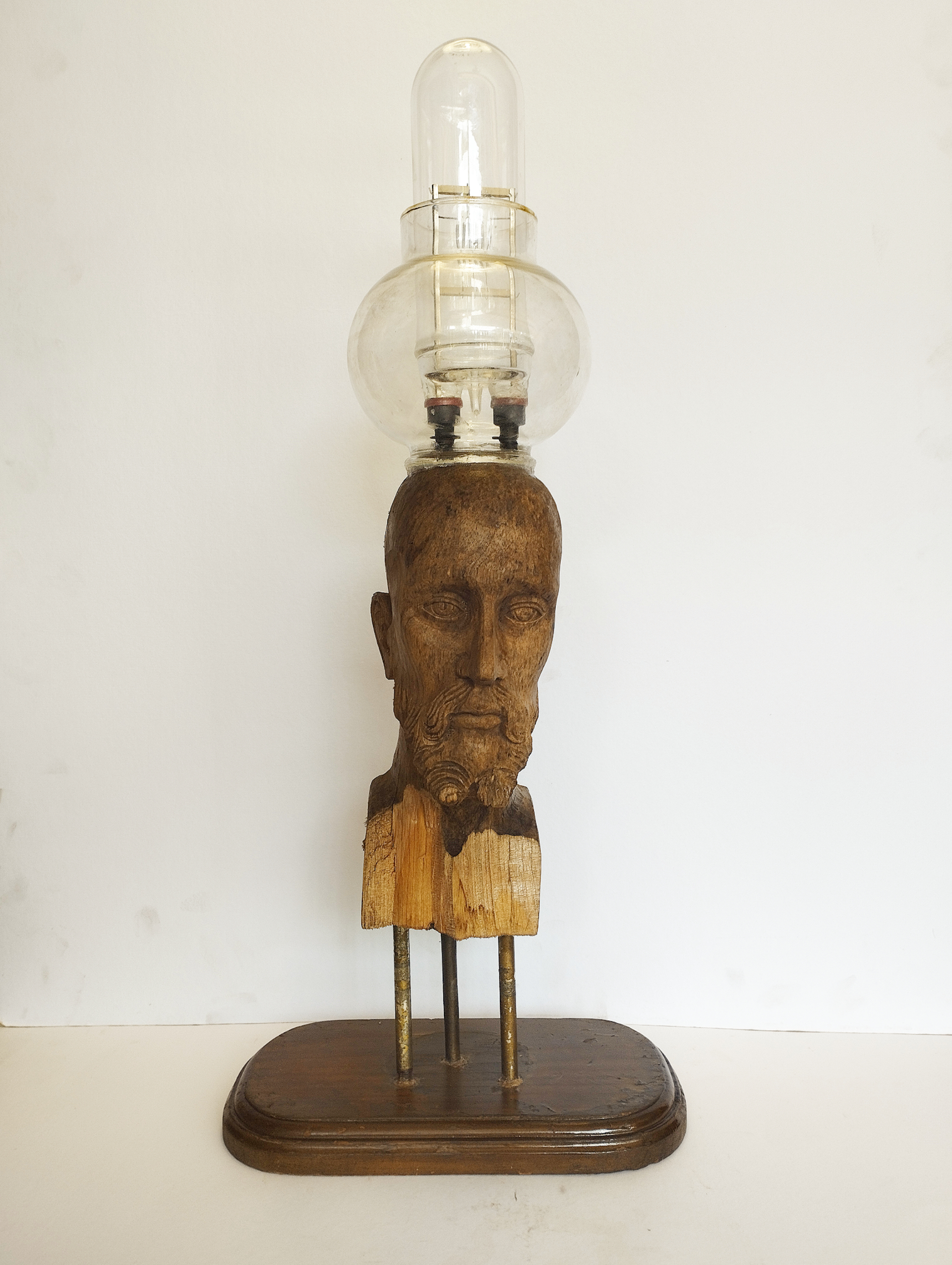
In a private collection, Rialto, California, USA
I wanted this piece to be exactly what its name suggests — but also something stranger. A carved head carrying a glass bulb on its crown like a crown of knowledge, or a saint's halo reimagined in hardware. There is something absurdly sacred about the moment of illumination. This work holds that moment still, frozen in wood and glass, asking whether the idea belongs to the mind that holds it or the light that escapes it.
In a private collection, White Plains, Quezon City
Origin is always in motion — restless, unresolved, still arguing with itself. I built this piece from the feeling that the beginning of anything is never a clean moment. It is always crowded: with what came before, with what didn't survive, with what was repurposed. The objects here don't agree on a single story. That disagreement is the work.
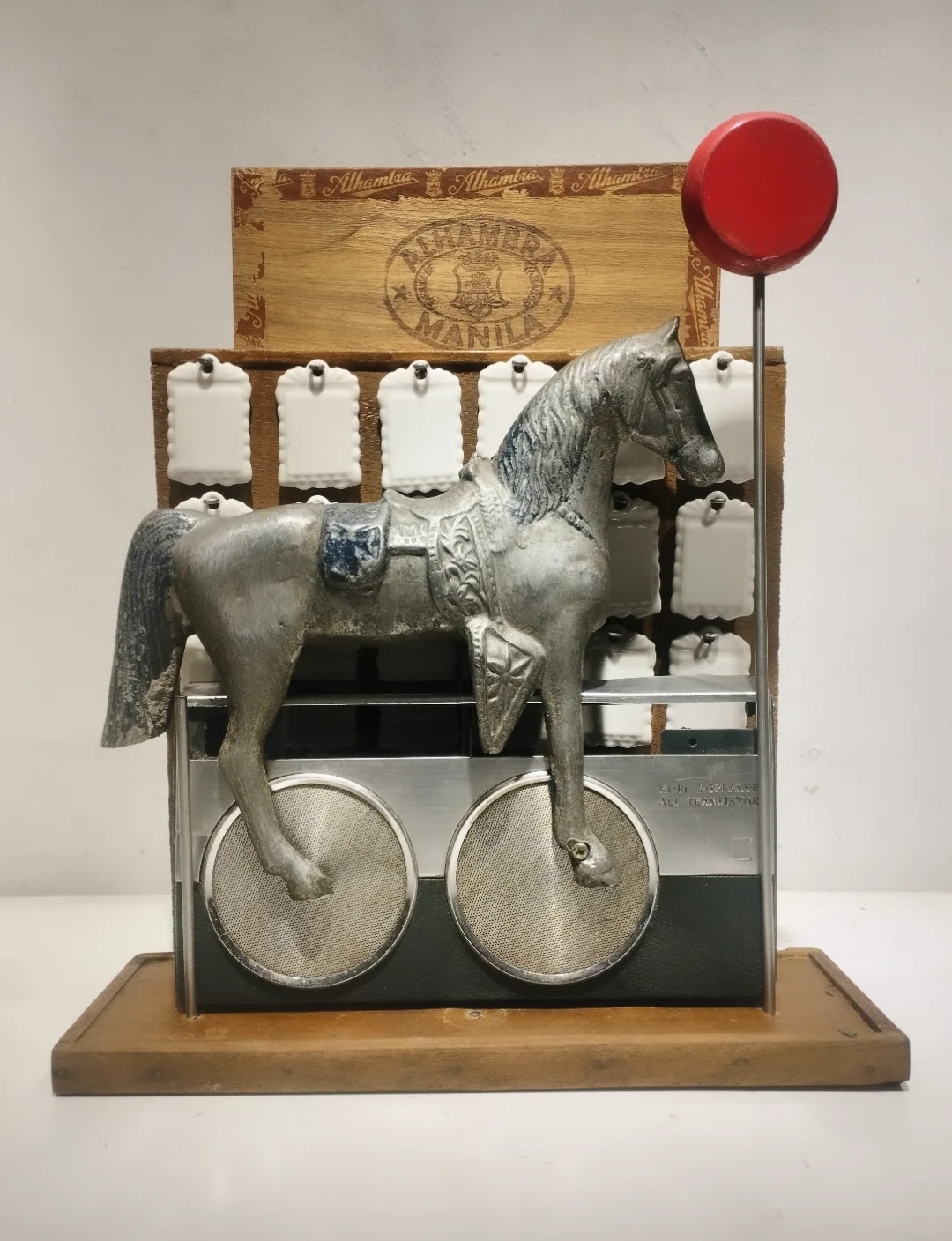
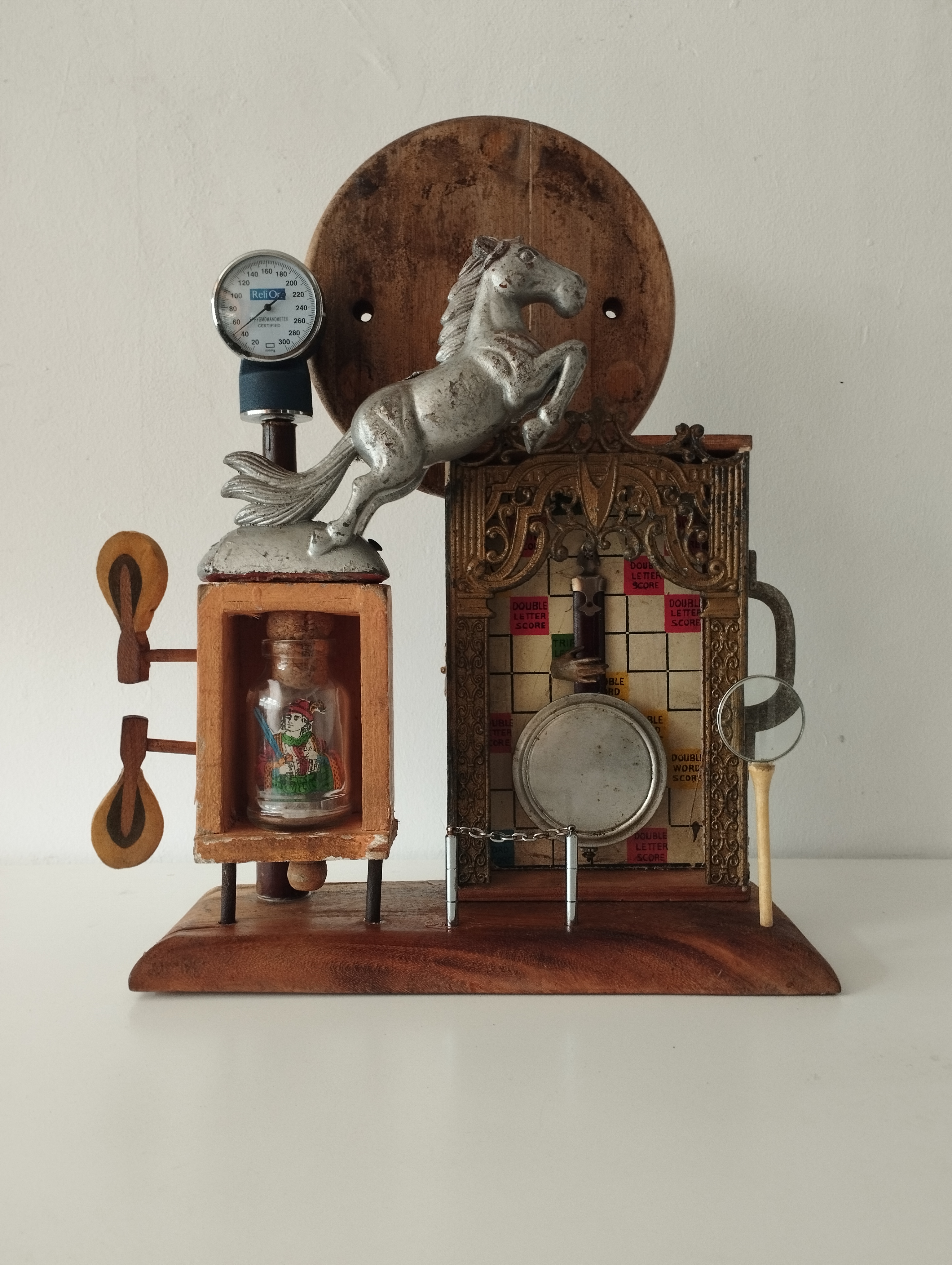
In a private collection, Casa San Miguel, Zambales
There is a kind of energy that objects carry not from electricity but from use — from the hands that touched them, the prayers spoken over them, the distances they traveled to arrive in the same room. This is a station for that other kind of charging. I built it thinking about rest as a form of accumulation, and about what it means for old things to become powerful again simply by being placed together with intention.
II
On protection, devotion, and what we carry across water
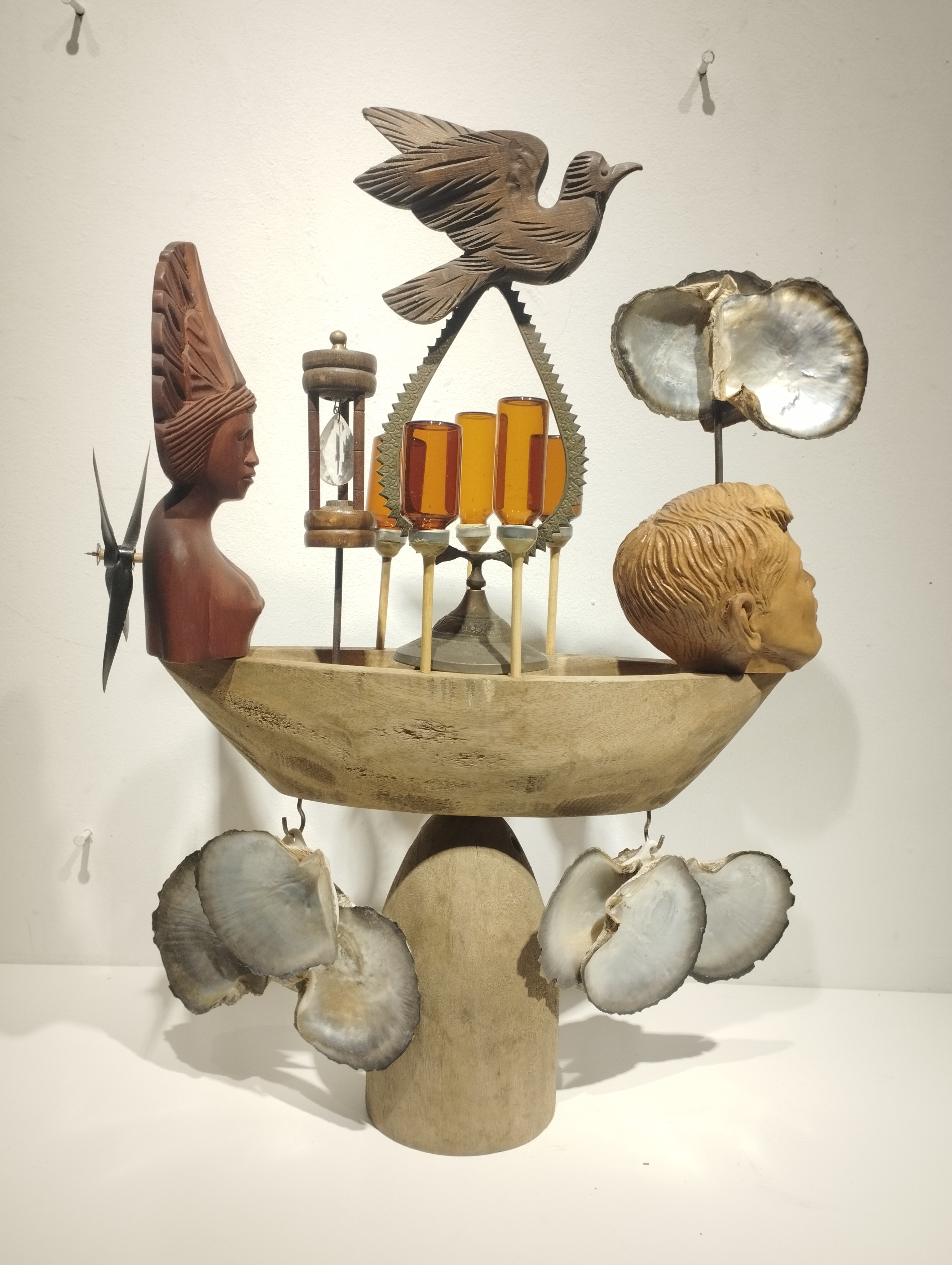
In a private collection, Bel Air, Makati
The sea in the Philippine imagination is never simply water. It is a threshold, a corridor, an ancestral memory that moves. I brought together folk-carved figures — the kind found in old provincial shops, the kind that used to stand on household altars — and surrounded them with what the sea leaves behind: mother of pearl, amber glass, the cold gleam of brass. They are guardians now, assembled from the materials of devotion and the residue of tides.
In a private collection, New York City
Cherubim in the old tradition were not small and rosy. They were terrifying — four-faced, winged, blazing. I wanted to recover something of that original strangeness. This assemblage borrows the form of devotional imagery and fills it with an unease that feels more honest than comfort. There is protection here, but it comes at a cost. The guardian asks something back from whoever it watches over.
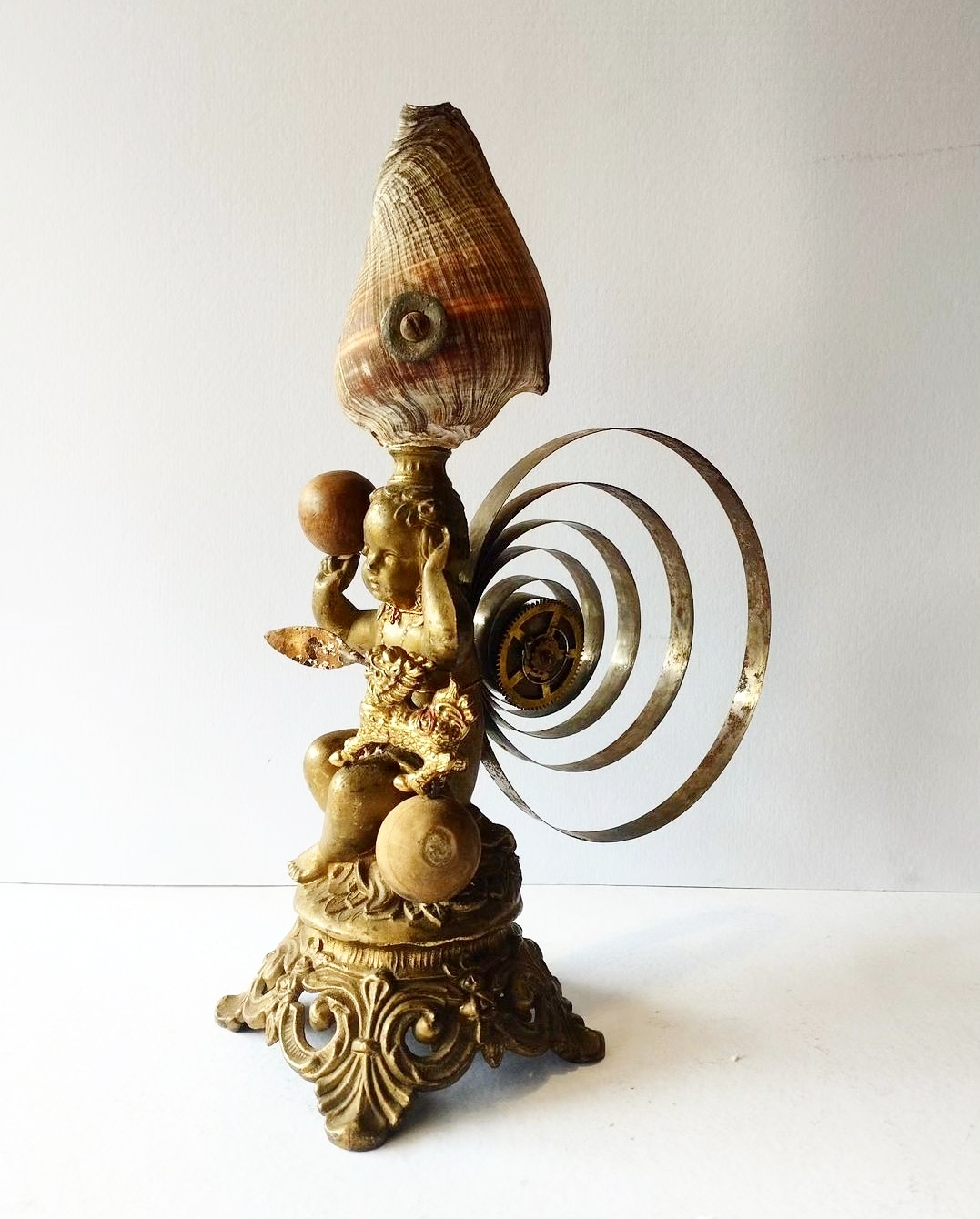
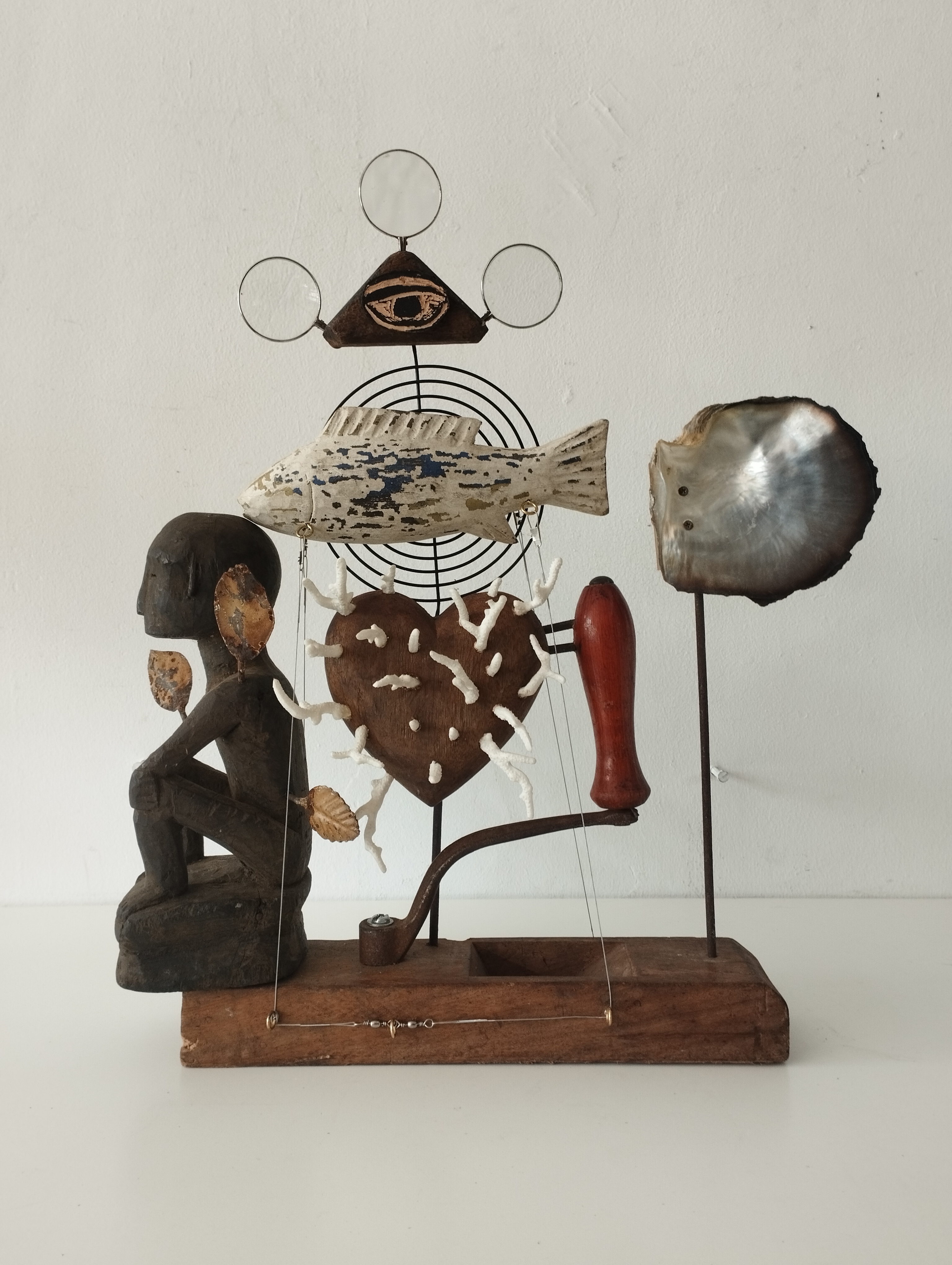
In a private collection, Bangkok
Kan-Laon is the ancient deity of the Visayas — god of the harvest, of time, of the volcano that still breathes above the sugarcane fields of Negros. I wanted to make a work that felt as old as that name, assembled from fragments that carry their own authority. This is not an illustration of mythology. It is an act of paying attention to what our indigenous world still holds, quietly, underneath all the borrowed religions and renamed mountains.
III
On movement, the sky, and things that arrive without being summoned
In a private collection, Calatagan, Batangas
To fly in the Filipino imagination has always carried a second meaning — the manananggal flies at night; the babaylan's spirit leaves the body; the soul of the newly dead takes wing toward the next world. This piece holds all of that ambiguity. Flight here is beautiful and unsettling in equal measure, constructed from wings that belong to no single creature, carrying something heavy toward somewhere unspecified.
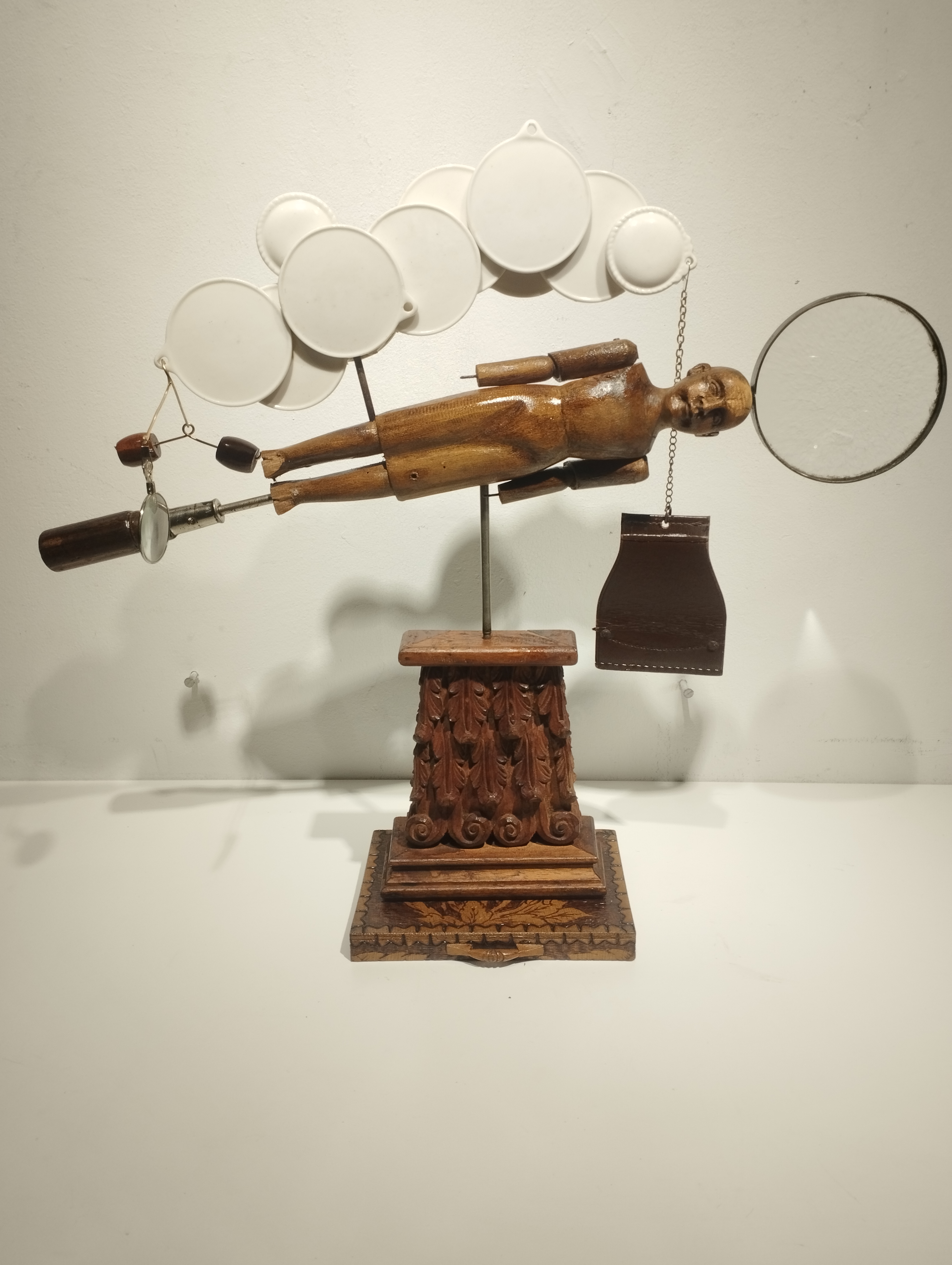
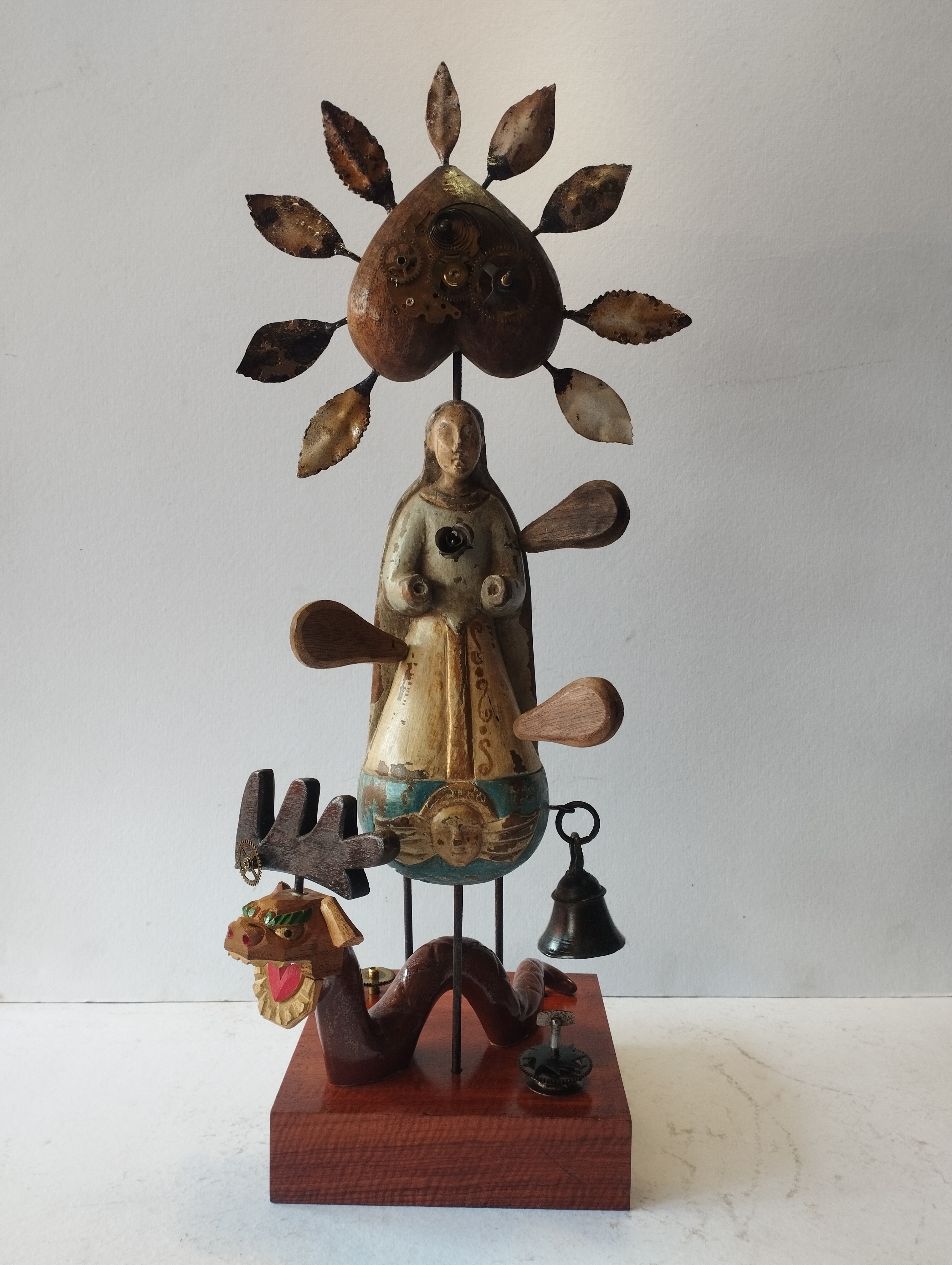
In a private collection, Quezon City
Every barrio in the Philippines has one — a story of something seen at the edge of the road, under the balete tree, at the hour between midnight and dawn. These are not ghost stories in the Western sense. They are reports. Testimonies of a world that is denser and more populated than the daylight version. I built this piece the way those stories are built: from a few solid facts, and then everything else that memory and fear and faith will lend.
In a private collection, California
There is a Filipino phrase for this — "bed weather" — the gray, rain-heavy air that makes every rational reason to move dissolve. The body becomes heavy with permission to stay still. I made this piece during one of those mornings: slow, provisional, stacked with the particular objects that only reveal themselves when you have nowhere to be. It is a small theater of suspension.
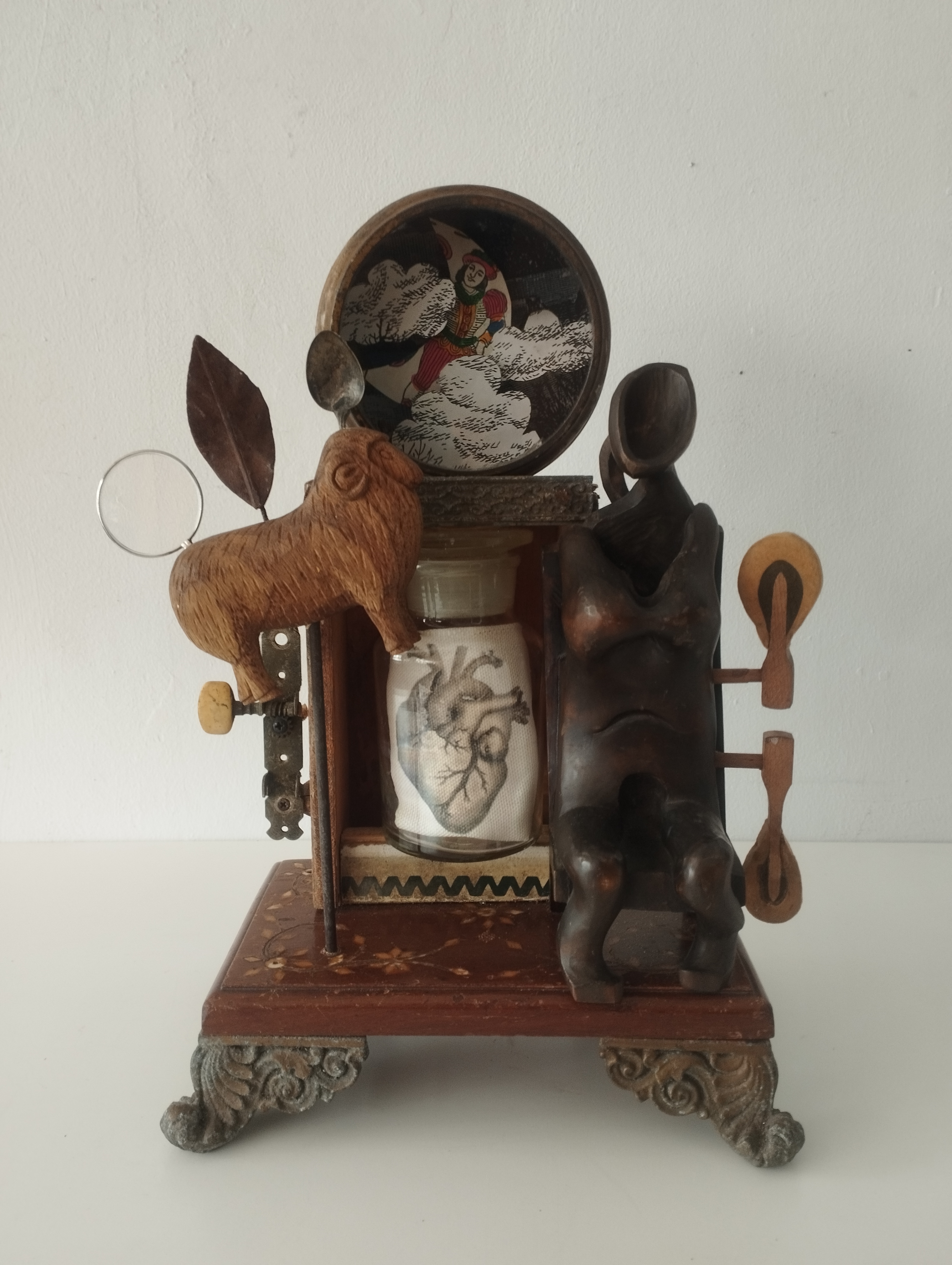
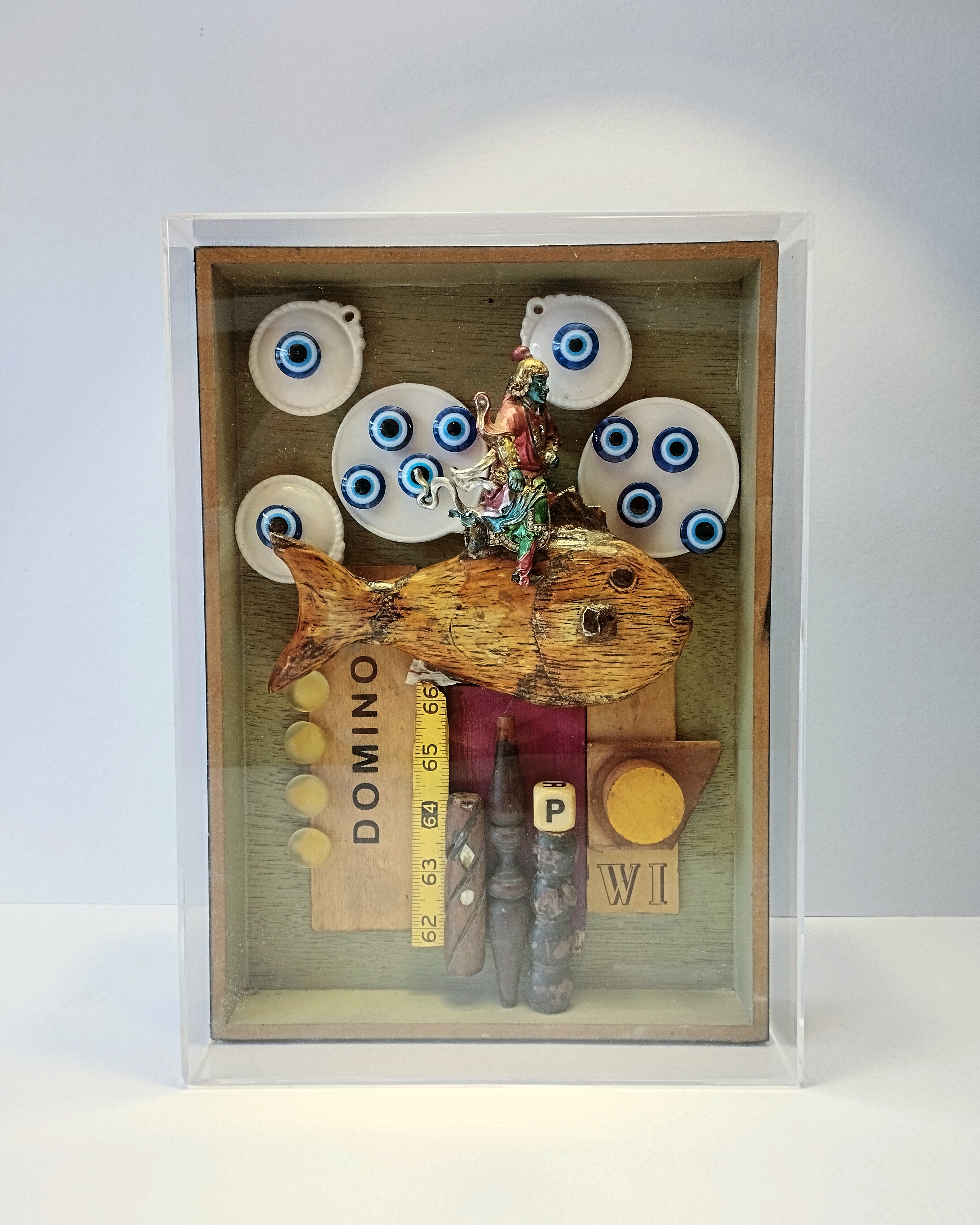
In a private collection, Madrid
What travels below the surface carries a different kind of knowledge. The submarine is a vessel for the unseen — navigating by instrument through water that admits no light from above. I built this thinking about the things that move through a culture underneath its official stories: the folk medicine, the suppressed deities, the practices that never stopped even when they were renamed. Things that travel in depth.
IV
On celebration, community, the stage of the everyday
In a private collection, Forbes Park, Philippines · Exhibited at Eskinita Art Gallery, Makati, 2022
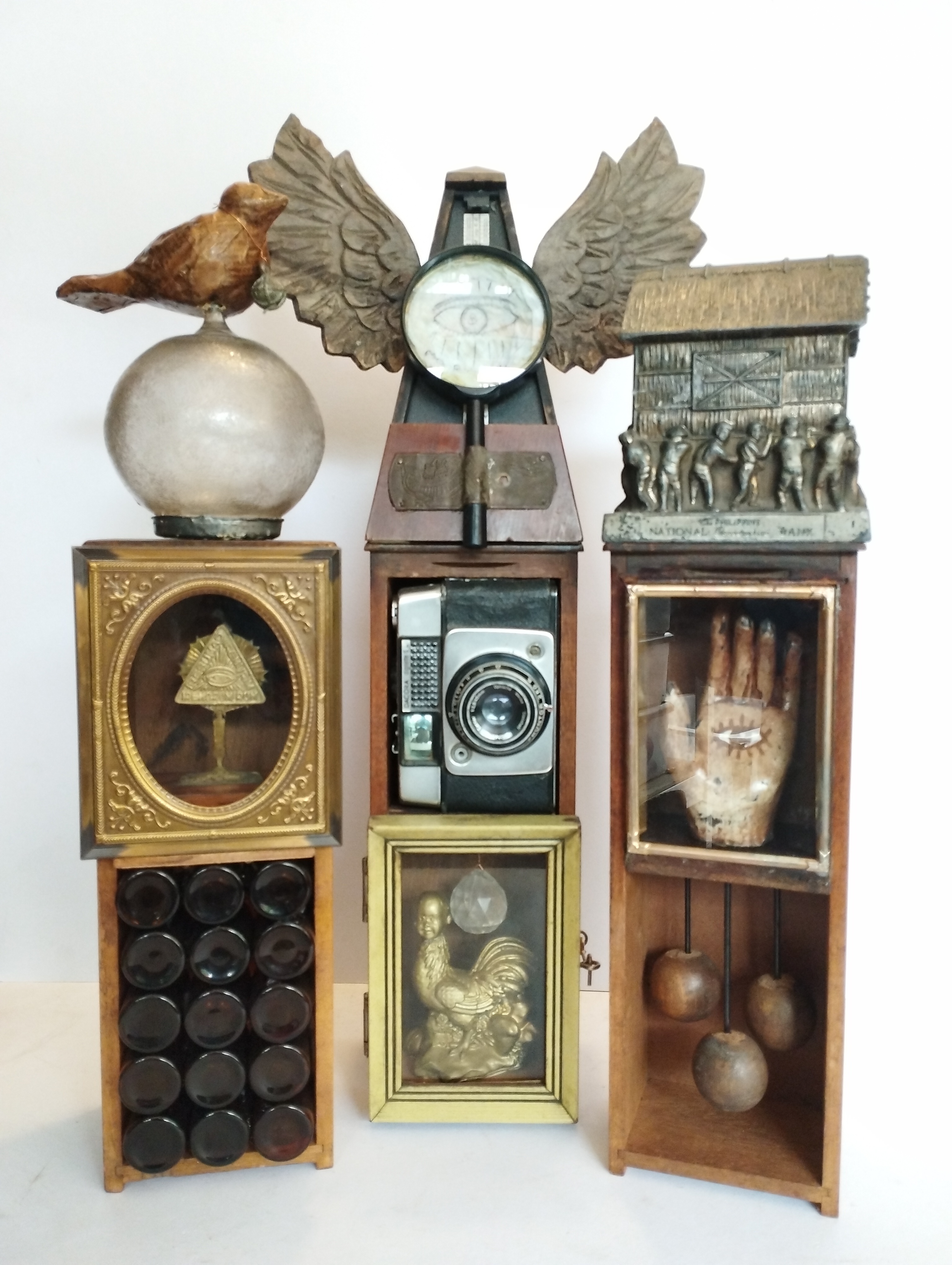
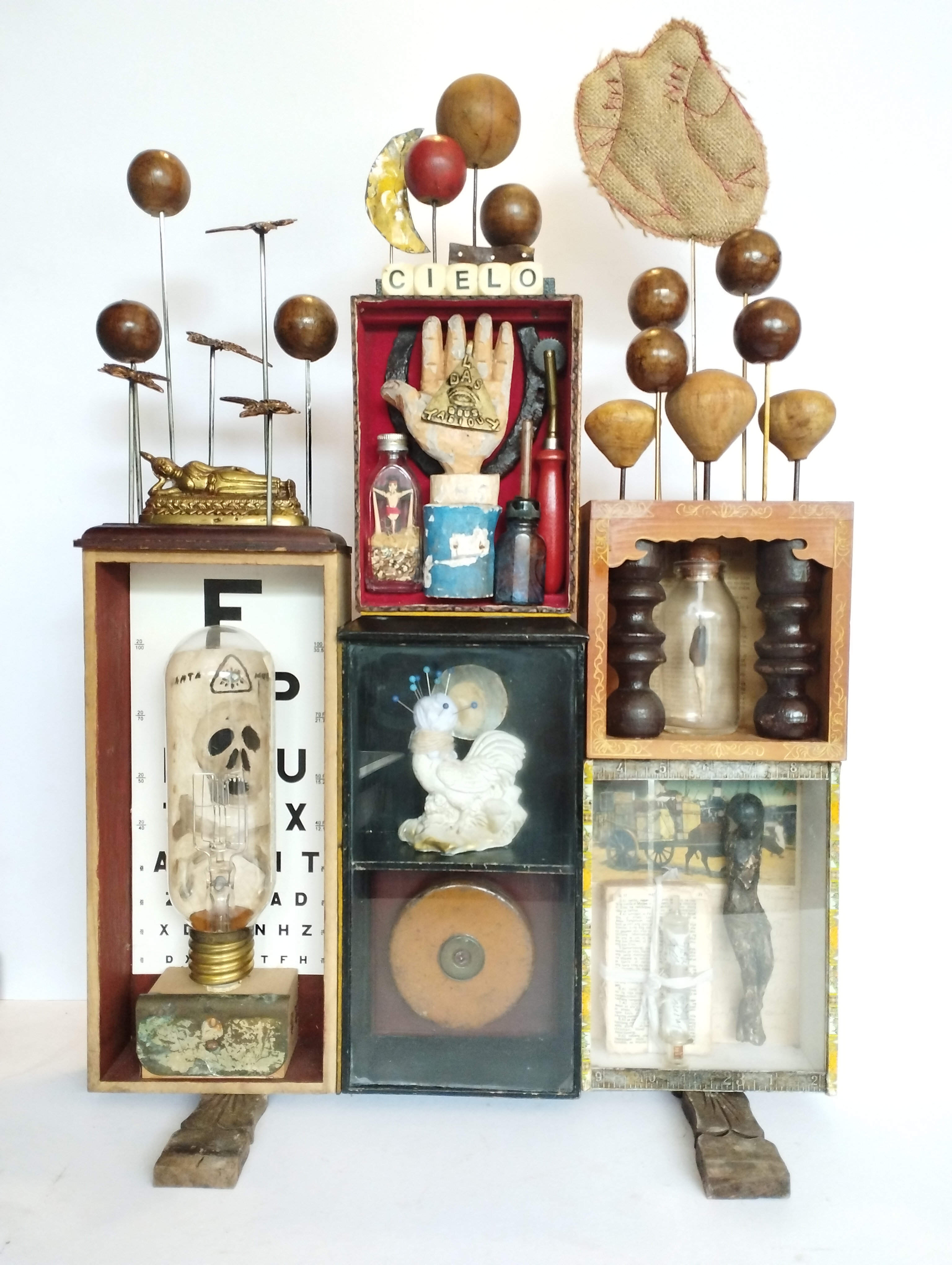
Community in the Philippine sense is not simply proximity. It is a negotiated territory of shared altars, borrowed tools, remembered obligations, and the particular noise of people who have decided to belong to each other. This triptych tries to hold all of that: the surveillance and the safety, the eye that watches and the hand that helps, the camera that records what the rooster already knew. Three cabinets. One neighborhood.
In a private collection, Makati
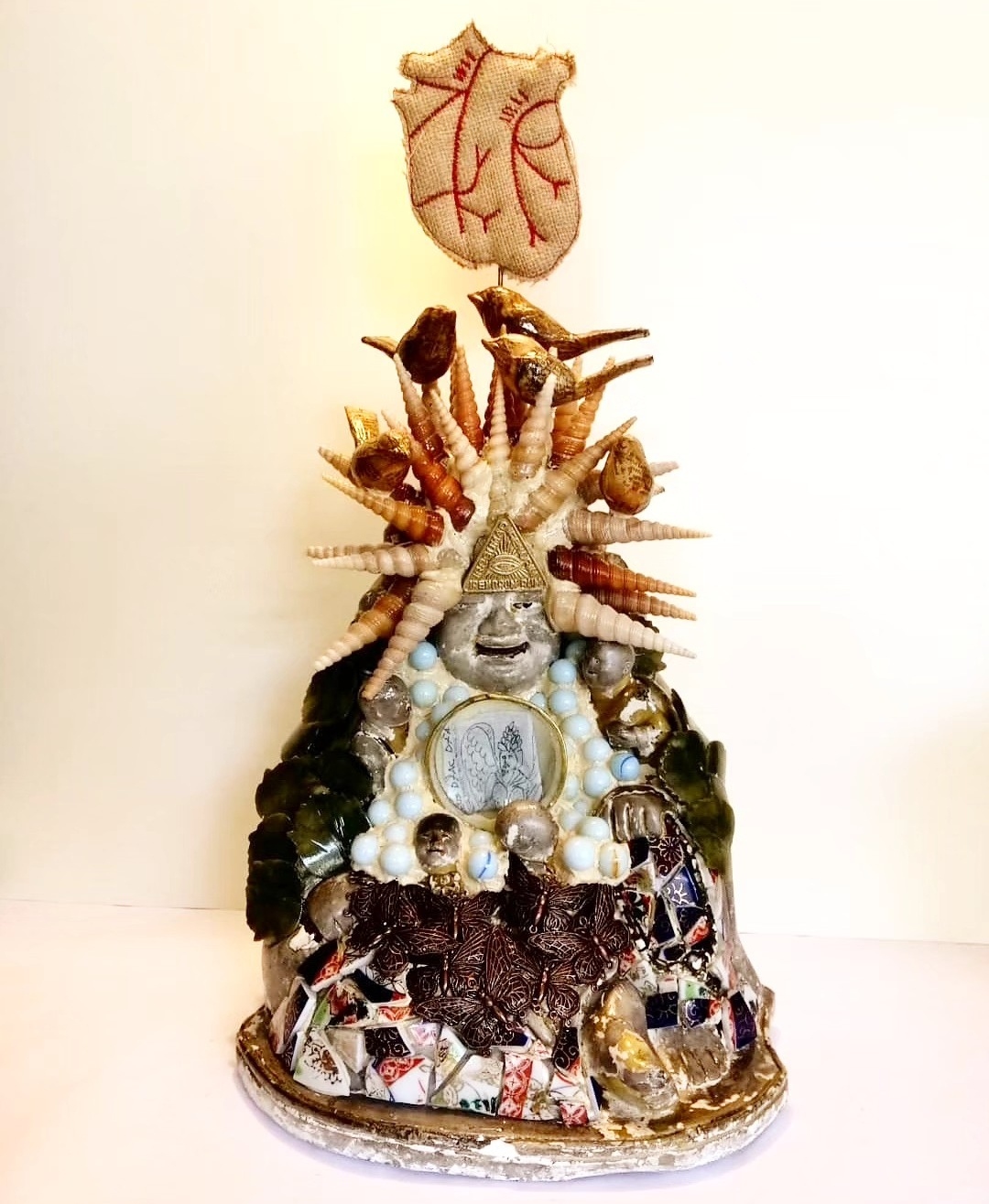
The sunburst is the oldest symbol of plenty — it appears in pre-colonial gold work, in the rays of the Katipunan sun, in the embroidery of fiesta vestments. I wanted to make a figure that carried all of that simultaneously: abundance, revolution, devotion, celebration. The three figures here are part Buddha, part babaylan, part barangay elder — assembled from shells and beads and ceramics — presiding over a world that refuses to separate the sacred from the festive.
In a private collection, Bangkok
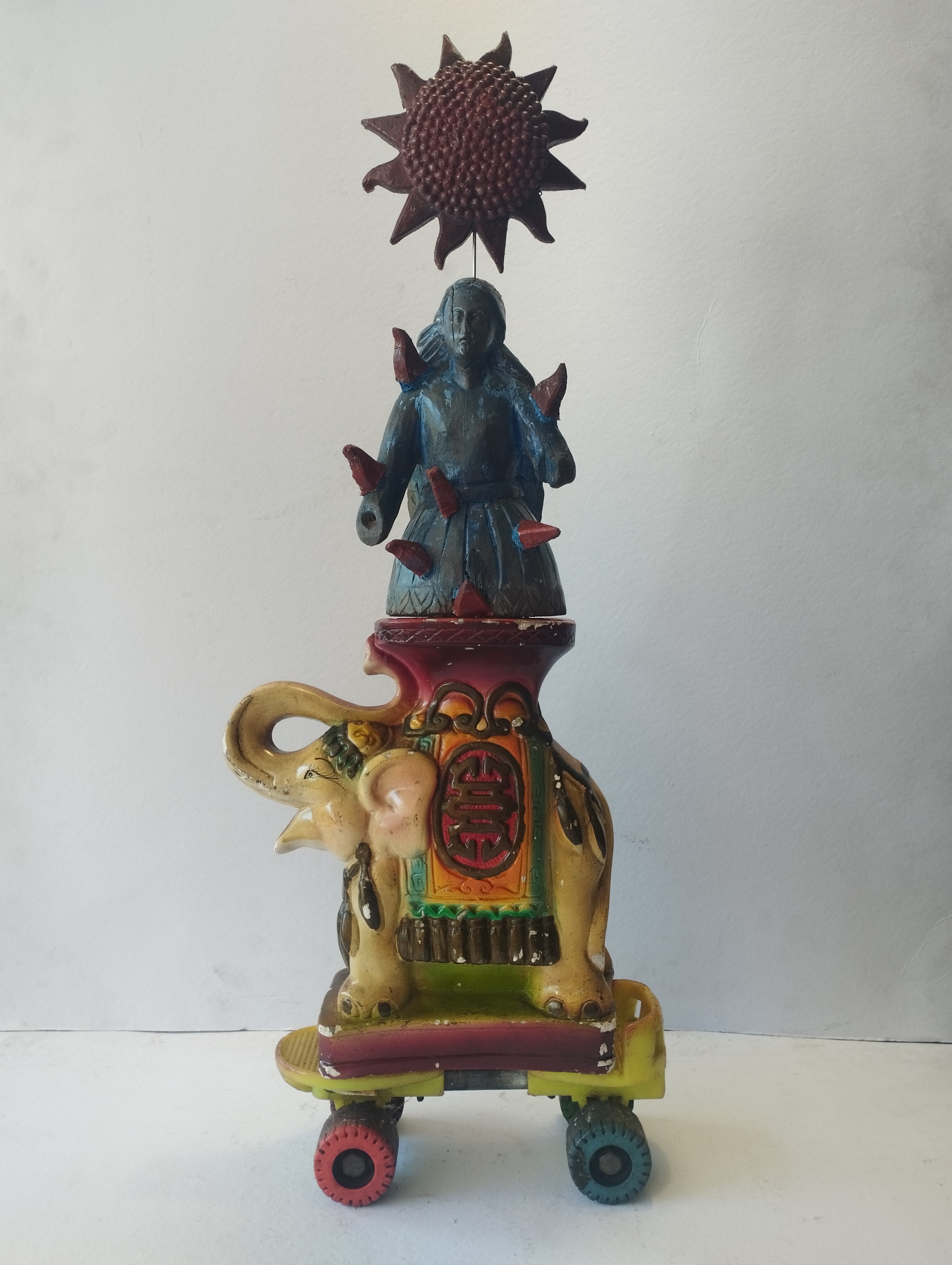
The carnival is where the rules of the everyday are suspended — where the clown and the saint stand at the same height, where the mechanical and the marvelous share the same stage. I've always been drawn to the Filipino perya: its tinsel and its danger, its impossible prizes and its beautiful noise. This piece is built from that memory — a tall, bright, unsettling column of festivity that doesn't quite behave like celebration and doesn't quite behave like warning.
In a private collection, Rockwell, Philippines · Exhibited at Eskinita Art Gallery, 2022
There is a particular Filipino joy that announces itself with theatrical generosity — the wide arms, the revealed gift, the tada that says: I made this for you, I thought of you, I carried this home. This piece is built from that gesture. It is an assemblage of arrival: objects placed with the energy of presentation, of something saved and something shared, of the moment before the bow.
V
On the mythologies that arise when cultures travel into each other
In a private collection, Silang
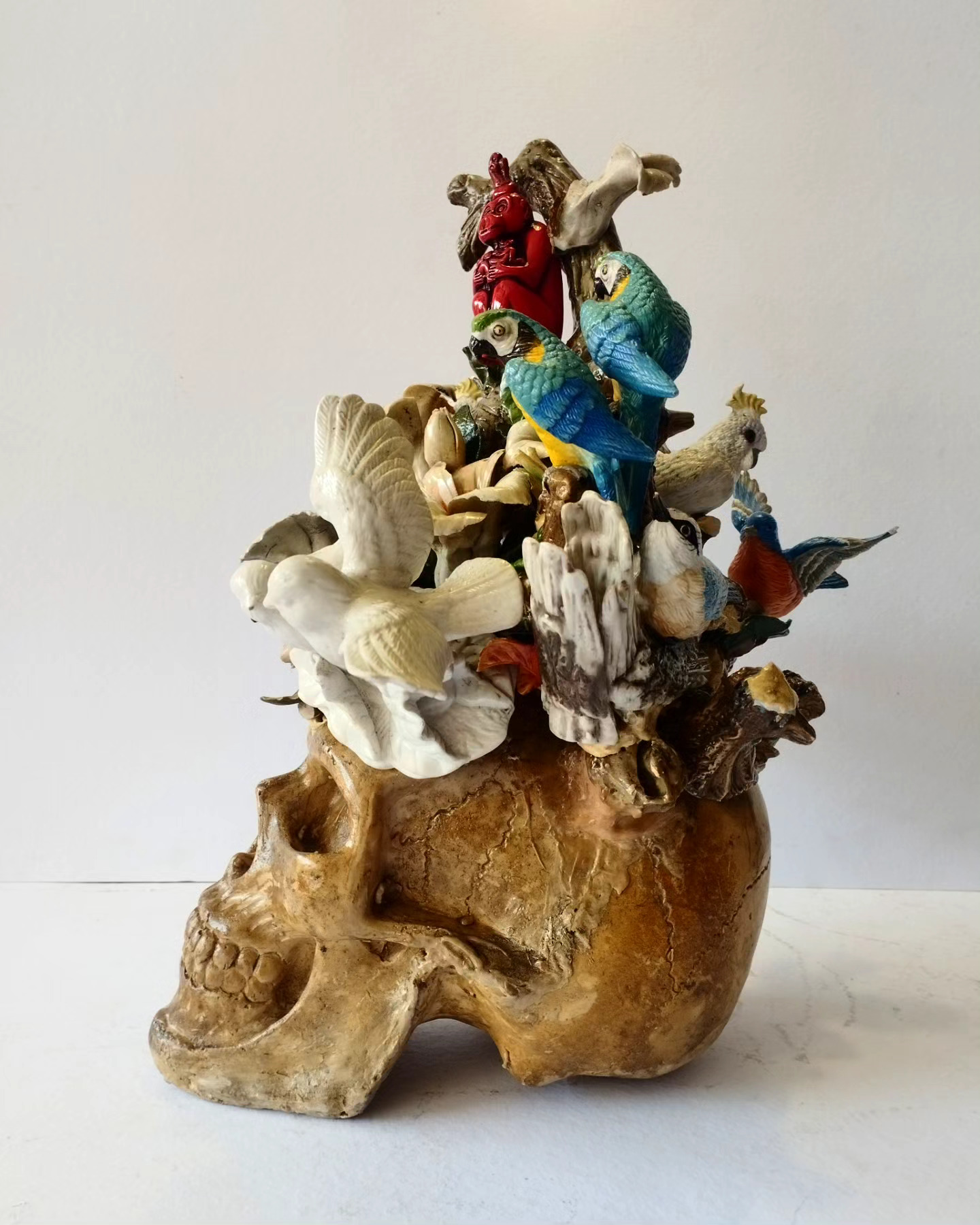
The Monkey King and the skull — two figures that travel across Asian and Latin American traditions, each carrying a different relationship to death, mischief, and transformation. I brought them together because they have always been traveling toward each other. The Philippines is the place where the galleon trade made those meetings possible — where the Chinese, the Mexican, the indigenous Malay, and the Spanish Baroque arrived in the same harbor and had to negotiate a shared altar. This piece lives inside that negotiation.
In a private collection, North Greenhills, San Juan
Not all ascent is spiritual. Sometimes it is mechanical — a series of platforms, a ladder of repurposed things, a structure that lifts simply because it was built to. I made this piece thinking about aspiration as a kind of carpentry: the deliberate stacking of one thing on top of another, the engineering of height from available materials. What rises here is assembled from what was already at hand. That is the only kind of ascent I trust.
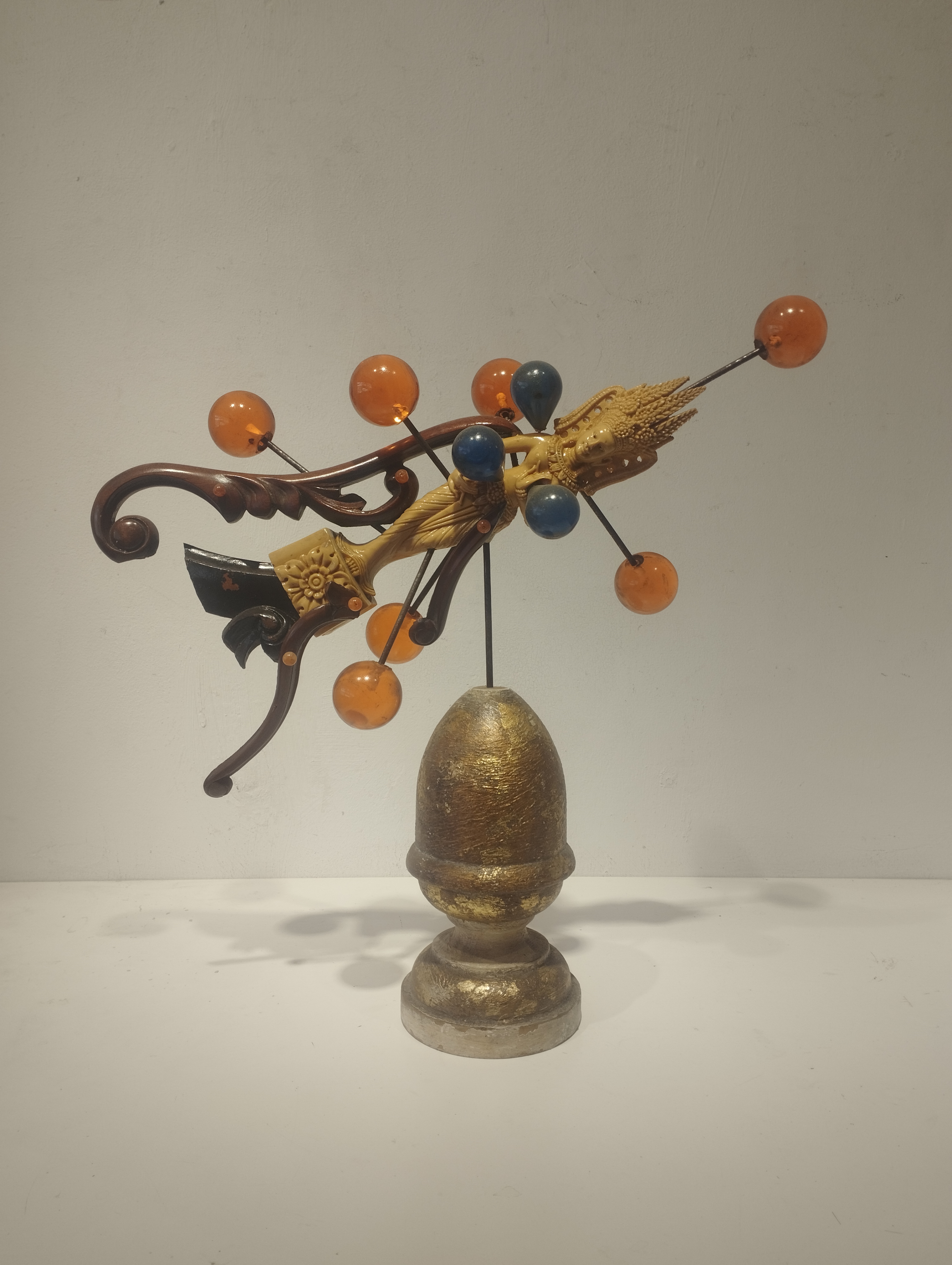
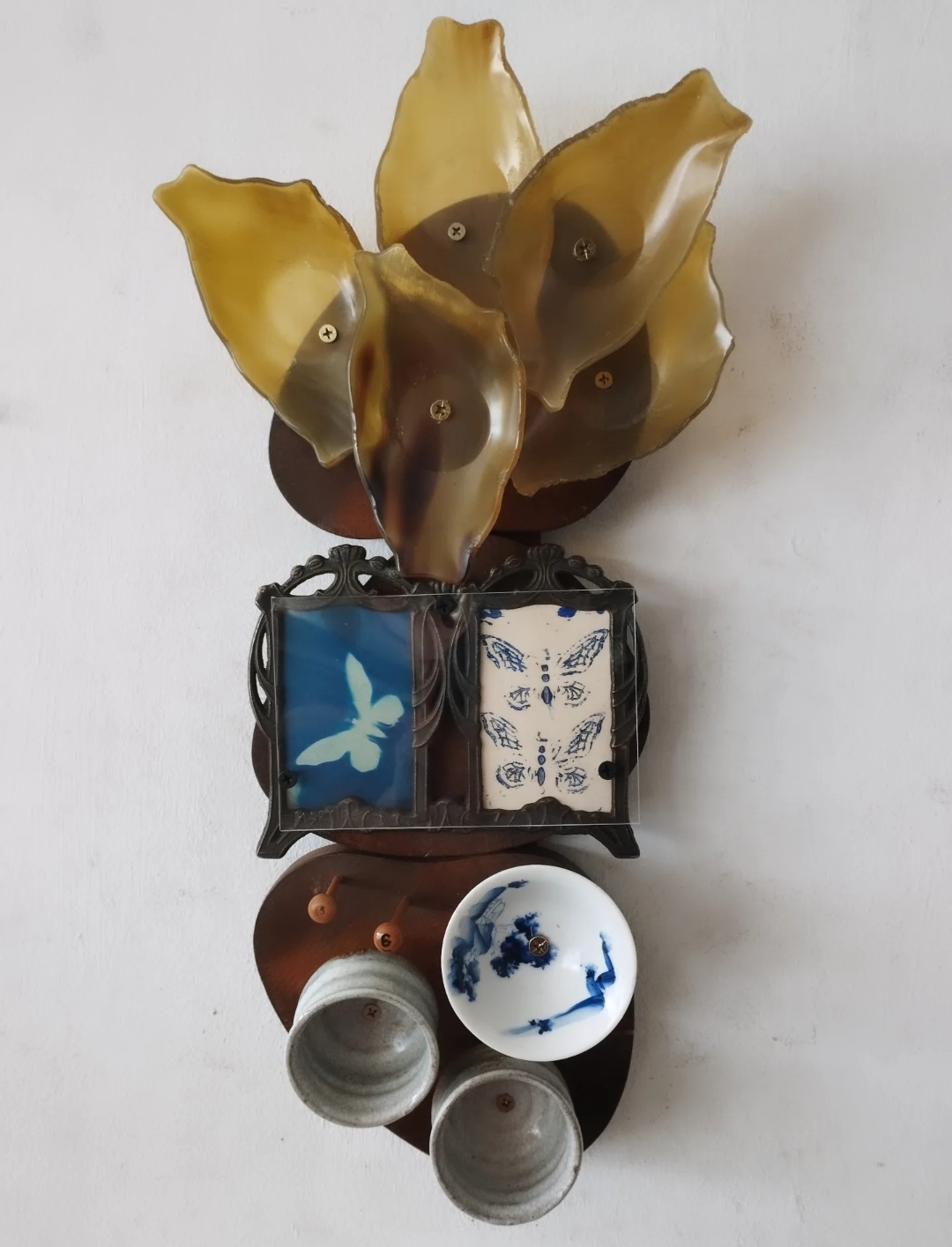
In a private collection, Finland
To be aportos — without port, without anchor — is the condition of everything I collect. Objects that have been separated from their original context, from the hands that first shaped them, from the purposes that gave them meaning. In assemblage, they find each other. This piece traveled to Finland with someone who understood what it means to carry something across oceans not as displacement but as continuation. The journey is part of the work.
"His works mine memory, nostalgia, dreams, history and many other themes. A very reliable sense of discovery and a natural curiosity about the world pervades his thoughtful and often playful work."
— Lisa Ongpin-Periquet, co-founder, Art Fair Philippines
"Martinez developed a style that is Filipino Baroque cast from primal religiosity — though inanimate, objects are filled and interpreted through anachronistic but intelligent manipulation and interplay of signs and symbols."
— Elmer Nocheseda, independent scholar, Philippine indigenous art and culture
"The pieces are historians of Filipino folklore and spirituality. Every time I look at his work, they whisper more and more details of their lore."
— Debra Price Jackson, cultural custodian and writer, Rialto, California
Artist Statement
As a passionate advocate of local heritage and cultural travel, I have amassed a collection of objects that touch on nostalgia and various aspects of culture from my sojourns over the past decade. In publishing my photo essays and travel narratives online, I uncovered a penetrating image of heritage — and discovered assemblage as a potent medium to retell curated memories, ruminations, and experiences.
By mixing unrelated ready-made objects and refashioning them in unexpected ways, I present a multiverse of interpretations of history, legends, and mythologies — freezing time in museum boxes, shrines, relic holders, installations, and sculptures.
I work with no formula, no set rules, guided by traditional design principles which I bend to make each composition engaging and timeless. I arrange, categorize, and layer disparate objects from different periods, places, and cultures according to the convenience of communicating allegories, allusions, metaphors, and elaborated fictions.
My assemblage pays homage to the curiosity cabinets from the Age of Discovery — which showcased the world as recreated, reinterpreted, and revealed by early explorers and travelers. My influences include Joseph Cornell, Man Ray, Louise Nevelson, Ron Pippin, and Vanessa German from the West; and Jose Tence Ruiz, Norberto Roldan, Riel Hilario, and Christina Quisumbing Ramilo from the Philippines.
The work holds the space between the ordinary and the mythological — and insists that the distance between them is much shorter than we assume.
About the Artist
Contemporary Assemblage Artist · Philippines
Glenn Martinez is a contemporary assemblage artist based in Rizal, Philippines. He became a full-time assemblage artist in 2020, developing a practice centered on the transformation of found and ready-made objects into storied artifacts that explore memory, identity, belief, local heritage, folklore, and cultural travel.
His works have been described as "Filipino Baroque" — objects charged with primal religiosity and layered with anachronistic intelligence, drawing the viewer to the threshold of the irreverent without quite crossing it. They are well-composed, open to multiple interpretations, and deeply personal without being opaque.
Martinez's assemblages are held in private collections in the Philippines, the United States, Spain, Thailand, Finland, and the United Kingdom, and in the permanent collection of Musee d'Arsie at Metro Iloilo Modern Arts Park, Philippines.
He documents his practice through two long-running blogs — Assemblage Champion PH and Traveler on Foot — and has been featured in the Manila Standard.
Exhibition History
Manila Hotel, Philippines · Group show with National Artist Kidlat Tahimik, Julie Lluch, Marcel Antonio, Maxine Syjuco, and others
Luneta Park, Manila · Joined San Mateo Artists Guild in the staging of the inaugural Luneta Art Fair
Altro Mondo Creative Spaces, Makati · Year-ender group exhibition
Altro Mondo Creative Spaces, Makati · Dual exhibition with Ral Arrogante
Makati City · Annual gathering of galleries and independent art spaces for the Museum Foundation of the Philippines
Create Gallery, CASA San Miguel Center for Arts, Zambales · Inaugural exhibition with Plet Bolipata, Elmer Borlongan, Carlo Gabuco, Leeroy New, and others
15square Art Gallery / Richard Buxani Studio, Imus, Cavite · Solo debut
Eskinita Art Gallery, Makati · Group exhibition with Macouy Gonzales, Darwin Japat Guevarra, and Richard Buxani
NCCA Gallery, Intramuros, Manila · Tribute exhibition for Riel Hilario; curated by Abe Orebia
Altro Mondo Creative Space, Makati · Duo show with Mario de Rivera
Fundacion Sanso Museum, San Juan · Workshop and group exhibition hosted by Fundacion Sanso and Epiphany Collective PH
Press & Writing
Manila Standard
A published feature on Glenn Martinez's practice and the sacred architecture of his found-object worlds.
Read Article →Artist Blog
The artist's primary documentation of his assemblage practice — process notes, exhibition records, and object studies.
Visit Blog →Travel Writing
The photo essays and travel narratives that first gave rise to Martinez's assemblage practice — heritage, culture, and the world gathered on foot.
Visit Blog →The Archive Continues
View available works, inquire directly, and follow the continuing archive of Glenn Martinez Assemblage. New works are released through Instagram — the primary space for collector inquiries and first access.
View Available Works on Instagram